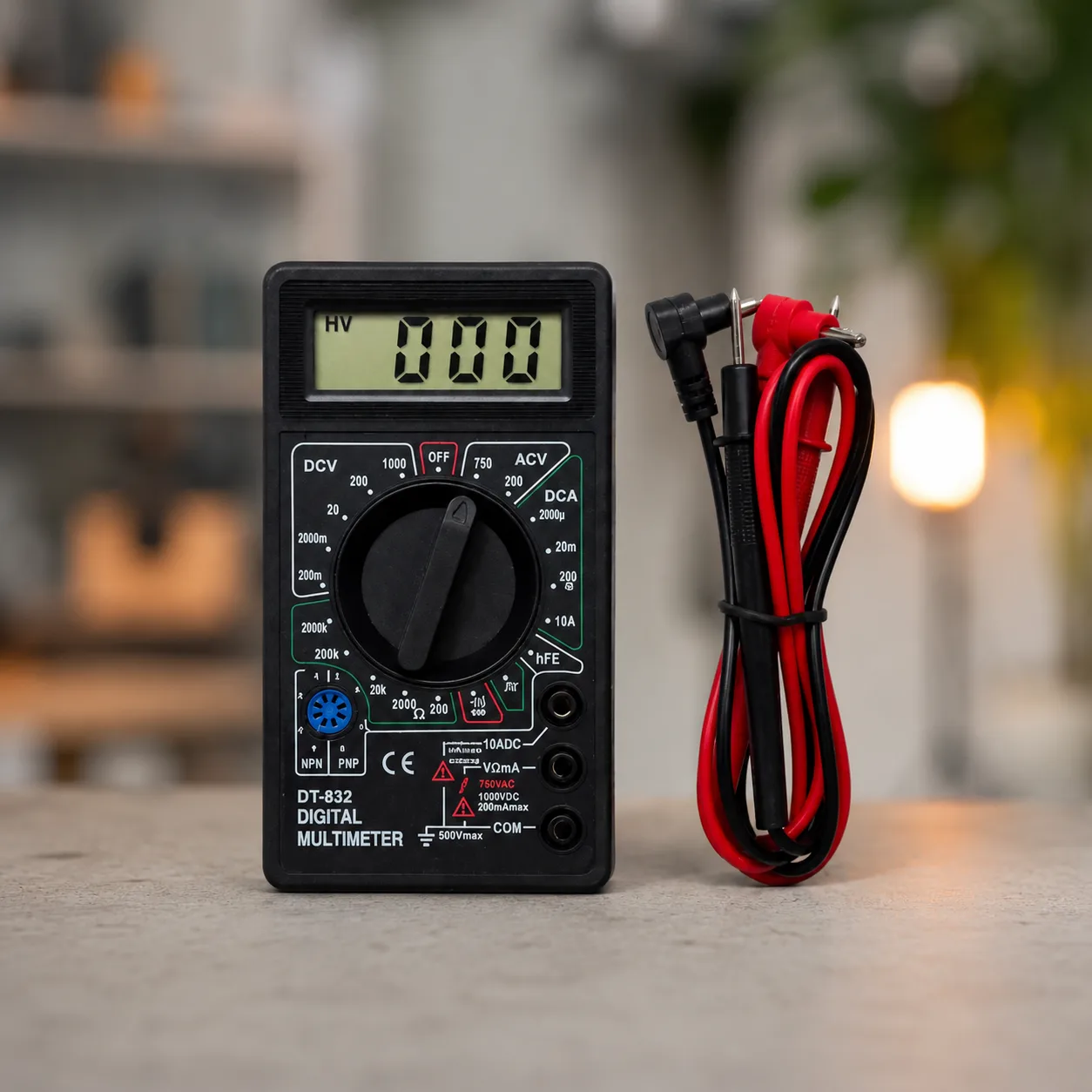
Digital multimeter DT-830B
Description
DT-830B Digital Multimeter Tester. The compact DT-830B digital multimeter is designed to measure: DC voltage (DCV range), AC voltage (ACV range), resistance (Ω range), DC current (DCA range), high DC current values (10A range), and it also tests transistors (hFE range), batteries (1.5V-9V range), and diodes (Diode range). Multimeter layout and operating rules: One of the probe sockets (the COM socket) is always in use, for any type of measurement being performed. Normally the black probe is connected to the COM socket. The red probe is connected to the VΩmA socket for measuring DC and AC voltage, resistance, and DC current up to 200 mA. To measure DC current above 200 mA, the red probe must be removed from the VΩmA socket and plugged into the 10A socket instead. To switch the multimeter off after measurements are finished, turn the rotary switch to the OFF position. Measuring DC and AC voltage (voltmeter mode): 1. First determine which type of voltage you're going to measure — DC or AC. To measure DC voltage (batteries, accumulators, DC power supply outputs, power circuits of most modern process-control sensors, thermocouple EMF) set the rotary switch to the DCV position (or V=). To measure AC voltage (a household electrical outlet, 220V UPS outputs, lighting circuits, power circuits of pump motors, fans, transformers and actuators) set the rotary switch to the ACV position (or V~). 2. After determining the type of voltage, you need to select the measurement range. If you don't even roughly know the voltage value being measured (for example, a "Krona"-type battery has 9V DC, while a household outlet has 220V AC), start measuring from the largest range, reducing the range until
Reviews
No reviews yet. Be the first!